Showing posts with label Erick_Vasconcelos. Show all posts

30 June 2015

Should debt just be abolished?

The Blog


Debt is simply a way of making the rich richer, and should be abolished.


That is the view of Erick Vasconcelos, writing at the Center for a Stateless Society (C4SS).

In his analysis published on 26 June, the antistatist writer takes note of the trail of debate and negotiation currently raging surrounding the sovereign debt of Greece:
The need for an “audit”, as opposed to the straight abolition of debt, is common within many sectors of the left (for example, former presidential candidate Luciana Genro included a “citizen audit” in her campaign platform in 2014). This happens because the left is viscerally afraid of delegitimizing power and the government, so for them only “illegitimate” debt should be dropped. However, the prerogative the government possesses of contracting debt and forcing the people to pay for them remains unquestioned. It’s, perhaps, another manifestation of the spineless shrillness of the left: for them, the government is powerless when faced with the external forces of capital, which demand that it incurs in ever growing debt.
Vasconcelos made no secret that his idea is radical and summed up his solution by urging, "Government debt is unjust. It’s immoral. It’s a system of income redistribution for the rich. It has to be destroyed."

The Blog


Enter your email address:


Delivered by FeedBurner
Read More »

17 February 2015

It’s Time to Destroy #DRM

@jfrost.


On January 20, the Electronic Frontier Foundation (EFF) announced the Apollo 1201 project, an effort to eradicate digital rights management (DRM) schemes from the world of Internet commerce.


Led by well-known activist Cory Doctorow, the project aims to “accelerate the movement to repeal laws protecting DRM” and “kick-start a vibrant market in viable, legal alternatives to digital locks.” According to EFF, DRM technologies “threaten users’ security and privacy, distort markets, undermine innovation,” and don’t effectively protect so-called “intellectual property.”

EFF’s aim is true. DRM plays a huge role in extending the life of intellectual property monopolies and their evil effects on creation and innovation. Indeed, as EFF notes, DRM has become so intertwined with our society that a world with no DRM technologies seems hard to fathom. The debate becomes even more relevant given the widespread adoption of 3D printing, which is capable of making many “IP”-protected goods, and given moves by corporations to extend post-purchase control over those who buy their products.

Keurig, for example, recently tried to market a DRM-protected coffee machine that only recognizes its own “official” pods. Consumers weren’t too happy to find out they would have to hack their own spresso machines to brew coffee, since the so-called “2.0” pods weren’t available in sufficient quantities to satisfy demand.


From Apple’s cat-and-mouse race with jailbreaking phone buyers, to Amazon’s move into “exclusive” programming for its streaming service, to Netflix’s region-blocking (enthusiastically supported by the Motion Picture Association of America, a powerful US IP lobby), to rampant user control schemes by console video game makers, DRM has a long record of enabling predatory behavior by politically privileged players in captive “markets.” The enforcement of “intellectual property” claims has become so extensive and intrusive that “rights holders” feel increasingly free to interfere in production of content formerly considered fair use.

While corporations try to set up force fields around the content they control, users find ways to consume it without monitoring, breaking locks and sidestepping restrictions. While corporations treat their customers as potential criminals and try to control them at every turn, “pirates” supply ease and comfort.

The DRM world and the larger universe of state-granted and state-enforced “intellectual property” monopolies are black holes of inefficiency and bad customer service. It’s no accident that large corporations and their political cronies love DRM. They fear a genuinely free economy — one with no “intellectual property” and no “digital rights.”

Citations to this article:


Enter your email address:


Delivered by FeedBurner
Read More »

16 January 2015

It’s Only Censorship When They Do It

@jfrost. #WikiLeaks. #CharlieHebdo. #journalism. #JeSuisCharlie.


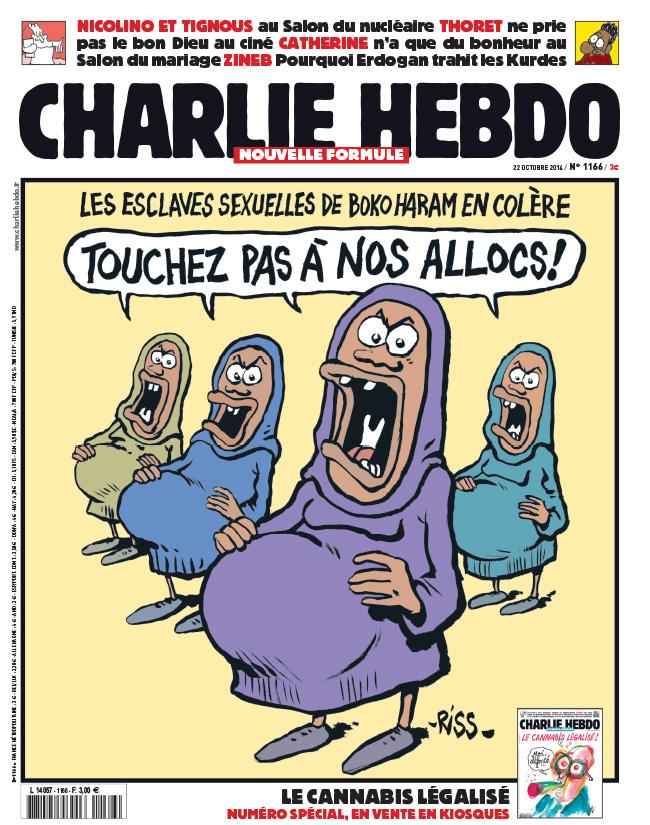
Racist cartoon used by the controversial magazine Charlie Hebdo

The deplorable attack on French satirical newspaper Charlie Hebdo, in which terrorists killed 12 and wounded 11, incited several reactions from the public, the sensitized media, and heads of state who hope to extract political gain from the matter. Amidst the generalized panic, Islamophobia has risen once again (due to the religious motivations of the attack) and Charlie Hebdo has been raised to icon status — contra the newspaper’s celebrated iconoclasm — with the #JeSuisCharlie campaign.

The human tragedy here, however, tends to multiply manyfold with its political exploitation by western governments, which have already started agitating their propaganda machines to foster a civilizational clash. French president Francois Hollande states that the attack was an act of “exceptional barbarism” against “a newspaper … in other words, an organ of free speech.” According to Hollande, it was an “act against journalists who had always wanted to show that in France it was possible to defend one’s ideas.”

US president Barack Obama doesn’t forget to highlight the obvious fact that terrorists, in sharp contrast to the state he represents, “fear freedom of speech and freedom of the press.” According to him, terrorists nevertheless will not be able to silence the fundamental idea shared by French and American peoples, “a universal belief in the freedom of expression.”

UK prime minister David Cameron reinforces that Britain stands “united with the French people” in opposition to terrorists and in defense of free speech. To German chancellor Angela Merkel, the shooting was also an attack against the “freedom of the press.” Brazilian president Dilma Rousseff, not to be left out, declared the shooting an “unacceptable attack against a fundamental value of democratic societies: the freedom of the press.”

Despite the barbarism and extreme violence of the attack on Charlie Hebdo, it’s not surprising to find that western governments are absolutely ecstatic with this event, which easily lends itself to their narratives of intrinsic western superiority relative to Muslim backwardness. Maybe they’ve waited for this all along: Something that makes their “they hate our freedoms” rhetoric sound less puerile.

After all, none of the countries so collectively outraged are prime examples of freedom of speech and freedom of the press. Charlie Hebdo itself adopted its current name in the 1970s to sidestep a ban on the newspaper put in place by the French government. France today occupies the unenviable 39th spot in Reporters Without Borders’s World Press Freedom Index, which highlights the weak source confidentiality protections in the country and steps the French government took to censor corruption-related recordings. The French state’s reiterated attacks on the Internet slide into the path of handing over total power to bureaucrats.

The USA, always looking after western freedom, apparently has no problems with suppressing information, seizing journalistic institutions’ phone records without warrant or due process, and arresting whistleblowers and journalists themselves. Not to mention the draconian and frankly ridiculous “intellectual property” laws used to silence dissent and maintain the corporate status quo.

We should ask ourselves if the UK’s new pornography censorship laws would allowsome of Charlie Hebdo‘s covers to be published. Germany’s politicians can barely control their happiness in censoring the Internet. And if Charlie Hebdo’s political cartoons appear harmless, what should we say about the extensive modification and mutilation of video games to match German bureaucrats’ sensibilities?

It is true that terrorists hate freedom of speech. But in that they differ little from western countries. They only employ different methods.

By Erick Vasconcelos - More articles by Erick Vasconcelos

Originally published at C4SS on 9 January 2015

Image credit: not required. To avoid hypocrisy, please do not censor.

Enter your email address:


Delivered by FeedBurner
Read More »

Featured

From Hormuz To Malacca: How The Iran War Is Reshaping The Indian Ocean

From Hormuz To Malacca: How The Iran War Is Reshaping The Indian Ocean By Uriel Araujo The crisis around the Strait of Hormuz and the US-Ira...

Follow Me on Twitter