Showing posts with label Philosphy. Show all posts

17 May 2016

Mont Order-related research available

The Blog


Research into the writings of Jean-Paul Marat in 1774  and their possible reapplication in the modern world has been made available at Dissident Voice and other websites and pages of the Mont Order society.


Quoting Marat's 1774 book The Chains of Slavery at length, the L'Ordre essay relates strongly the origins of the Mont Order's legendary name in the chaos of the French Revolution. As such, it is an attempt to guide the Order and keep its overall philosophy in concert with its origins and associations.

Some conspiracy theorists believe the Mont Order and the Montagnards who created the French Republic and executed Louis XVI before apparently disappearing into the chaos are one and the same.

Theories aside, the L'Ordre essay is an authentic Mont Order document at the Dissident Voice publication, and does express great interest in the revolutionary rhetoric responsible for inspiring the French Revolution. It calls for this to be reapplied in the modern world, with western democracies having gone astray and failed to accomplish what the French and American Revolutions hoped to do.

Jean-Paul Marat was a French physician, journalist and key influence on the "Mountain", who became a martyr of then-new liberal nationalist ideas following his assassination in 1793. Marat lived with a debilitating skin disease, often in exile and hiding in sewers to escape persecution during his political life, while he ran the dissident newspaper The People's Friend.

In its conclusion, the Mont Order essay asks the Order's members to emulate Marat. "Being strongly related to the Mont Order association's own name and hopes, Marat is an ideal role model", L'Ordre argues. Dissidents should therefore be encouraged to be powerful, awe-inspiring individuals who "act bravely against the unproven government and international system" and in Marat's words, "bring the ax to their root" when it comes to dealing with injustices.

Notable differences between the Mont Order and the French Revolutionary thinkers include a lack of interest in patriotic nationalism, with this being archaic in a high-tech modern environment with everyone connected through the internet.


The clubof.info Blog

Read More »

18 March 2016

Existential risks don't matter to politics

The Blog


Current political science and ideology concentrates on the liberties of the individual, therefore lacks any and all theoretical grounds to bother opposing "existential risks" to human progeny or civilization, a blog post asserts.


This view, based on an unpublished review of a Lifeboat Foundation book, appears in a Beliefnet post. The argument goes that there is a lack of support in existing political theory for the pleas of Stephen Hawking, the Lifeboat Foundation boards, and countless other futurists and scientists who say space colonization should be pursued to ensure the perpetuation of the species.

No one in modern politics will be moved by the notion of safeguarding human posterity. In fact, most governments and political movements do not care for the long-term survival of humankind and will never invest any effort in it as their priorities are very clearly elsewhere:
[worrying about posterity] it is contrary to existing political norms. The prevailing liberal, centrist, libertarian and even socialist philosophies in the west today mainly focus on the rights, pleasures, and just treatment of individuals. Where they are concerned, it doesn’t actually matter if no humans exist a couple of centuries from now, as long as people didn’t die painfully.
To put it more consequentially, this means no electable politician or political scientist in the west would be swayed by negative-minded futurist arguments about saving humans from existential risks. Basically, the idea of posterity - of saving future generations to inhabit the world or even other worlds beyond - is completely unheard of to politicians and social science experts and cannot be expected to impress them.

Calling this problem a "gap on all our bookshelves", where there is simply no valid political theory and a lack of literature about why to save civilization or ensure posterity, the blog repeats its earlier value judgment that global injustice is ultimately worse than extinction in any binary choice between the two.

Maybe the political science is on the right track. If the current social system is unjust, efforts to save civilization are only about saving injustice.


The clubof.info Blog

Read More »

20 January 2015

#Violence and #Euphemism: #warcrimes

@dissentingleft .


I hate when people support violence, but claim to advocate non-violence. We see it when a liberal condemns protesters for rioting but then advocates laws that enable armed police officers to arrest and armed guards to cage people for possessing firearms. We see it when presidents who use cluster bombs against civilians condemn violence by protesters and foreign governments.


The plain truth is that many people don’t see the violence they support as violence. Incarceration, though clearly carried out and enforced through violence, is not often discussed as a form of violence in our society. Nor is arrest, though it would be kidnapping if a private citizen carried it out. In most discourse, violence is shrouded in euphemism, to soften its harsh and brutal reality.

The simple fact is most people support violence in some cases. The problem is that it sounds bad to say you advocate violence, particularly in liberal circles, so they use euphemisms to talk about the violence they advocate. I’ve found that in the rare cases when this is called out, many people implicitly (or in some cases explicitly) make the argument, “It’s justified, therefore it’s not violence,” as though violence ceases to be violence when carried out for good reasons. The trouble with making “non-violence” part of your identity is that you start denying the nature of the violence you support, rather than recognizing that some violence may be justified and accepting the burden of proof required to justify your preferred forms of violence.

This is one of the few ways in which I think both conservatives and Marxist-Leninists are better than many liberals. Conservatives and Marxist-Leninists both tend to be fairly upfront and bloodthirsty about the violence they advocate, rather than assuming it away. Many conservatives explicitly and overtly defend and even praise torture, war, police brutality, and violent and abusive prison conditions. Many Marxist-Leninists joke about and glorify gulags, firing squads, and revolutionary combat. I find these views repugnant, but at least the violence is up front for all to see, rather than concealed. When euphemism conceals violence, this prevents honest discussion of violence, and implicitly lowers the burden of proof by concealing costs in any cost vs. benefit calculation.

That said, there are very real dangers in the approach that glorifies violence rather than euphemistically concealing it. By moving away from treating violence as bad and concealing it when you advocate it, you can move towards glorifying the violence you support, and thus become much less careful and cautious in evaluating whether the violence you support is justified. In a society with open and diverse debates, this may not work, as you will likely face challenges from those who see the violence you support as horrible, or at least questionable. But if you form a bubble, if you move towards what Julian Sanchez calls “epistemic closure,” it becomes very easy to escalate your support for violence. You talk with others who openly support this violence, you dehumanize the victims, and the violence ceases to be seen as a necessary evil, instead becoming a form of glory. The war becomes not just the tragic cost of freedom, but the ultimate in heroism. Torture becomes not a necessary evil to stop terrorism, but just desserts for Muslims who you have condemned as barbarians. The gulag and the firing squad become not merely a regrettable but necessary defense from counterrevolution, but glorious and exciting justice against capitalist pigs.

Given how destructive violence is, I think we ought to be very careful about when we consider it justified. My own approach sees violence as ethically constrained by a classical liberal theory of individual rights. In particular, I support the non-aggression principle, which says that violence can only be justified in defense from aggression against persons and property. Furthermore, I think that even when an act of violence isn’t precluded by this principle, we should still be quite cautious on the question of whether it’s desirable. Some acts of aggression may be resolved or prevented by non-violent forms of governance and dispute resolution, such as reputation mechanisms, ostracism, graduated sanctions, or a restorative justice process.


Perhaps my theory is wrong. All supporters of states would reject my theory, as it rejects the existence of states outright. Some anarchists would reject my theory, as it allows for violence in defense of property rights and precludes some forms of revolutionary violence. But in order to evaluate whether it’s wrong we must look at it honestly. We must recognize the violence it permits as violence, and we must then determine whether it’s justified. Distorting language to conceal violence does not help our inquiry. If you support prisons, police, gun control, or even if you’re like me and just support self-defense, you support violence. Own it and argue honestly for it.


Enter your email address:


Delivered by FeedBurner
Read More »

2 January 2015

"West" enslaves, robs world for liberty

. @kevincarson1. #liberty. #democracy. #equality. #hypocrisy.

Wish You’d Stop Bein’ So Good to Me, Cap’n


You may be familiar with Murray Rothbard’s article “Egalitarianism as a Revolt Against Nature.” Hans-Hermann Hoppe, beloved eminence grise at LewRockwell.com, takes things a step further and makes belief in human inequality the defining characteristic of right-libertarianism (“A Realistic Libertarianism,” Sept. 30). This isn’t just a hill he’s willing to die on, but a hill on which he’s willing to make his own one-man reenactment of Pickett’s Charge.
The Left… is convinced of the fundamental equality of man, that all men are “created equal.” It does not deny the patently obvious, of course: that there are environmental and physiological differences, i.e., that some people live in the mountains and others on the seaside, or that some men are tall and others short, some white and others black, some male and others female, etc.. But the Left does deny the existence of mental differences or, insofar as these are too apparent to be entirely denied, it tries to explain them away as “accidental.”…
In fact the Left (or at least most members of it) does not deny that there are differences in individual ability and intellect. But never mind that. Hoppe isn’t satisfied to stop there:
…[The right libertarian] realistically notices that libertarianism, as an intellectual system, was first developed and furthest elaborated in the Western world, by white males, in white male dominated societies. That it is in white, heterosexual male dominated societies, where adherence to libertarian principles is the greatest and the deviations from them the least severe (as indicated by comparatively less evil and extortionist State policies). That it is white heterosexual men, who have demonstrated the greatest ingenuity, industry, and economic prowess. And that it is societies dominated by white heterosexual males, and in particular by the most successful among them, which have produced and accumulated the greatest amount of capital goods and achieved the highest average living standards.
Some people might see an internal contradiction between Hoppe’s repeated use of the term “dominated” to describe the role of certain privileged segments of society, and the idea that “libertarian” ideas were formulated by societies based on domination.

But obviously Hoppe does not, since he makes little effort to hide his salivation at the prospect that his avowedly principled belief in self-ownership, non-aggression and rules of initial acquisition will have the effect — just coincidentally, of course — of perpetuating the domination of these same white heterosexual males. So the primary beneficiaries of the ideas of liberty that straight white men invented will be those same straight white men.

Hoppe is fond of arguing that every single bit of naturally scarce property should be assigned to “some specified individual.” From there, in a typical restatement of his stock argument, he goes on to assume the universal appropriation of all land within a country. And with all land in the entire country, including roads, under individual ownership, it follows that nobody can enter the country or travel along any stretch of road without the permission of some private landowner or landowners. This, at one stroke, solves the “problem” of immigration, since — although national borders as such do not exist — no one but an invited employee or bracero can enter a universally appropriated America without trespassing on somebody’s land. It also solves the gay rights “problem” since, the country being composed overwhelmingly of God-fearing Christian folk like Hoppe himself, nobody will want “those people” on their property. If you find the libertarianism of Thomas Paine and William Godwin hard to stomach, through the miracle of universal appropriation you (assuming you’re a straight white propertied male) can make your own “free” neo-feudal society in the image of The Handmaid’s Tale.

Maybe everybody else who’s not straight, white or male will benefit from having those smart straight white men managing them for their own good.

Hoppe’s ideas of universal appropriation don’t seem to hold up so well, though, at least from the perspective of someone without Herr Doktor Professor Hoppe’s Mount Rushmore-sized brain. Even among right-libertarians, the usual standard of legitimacy in private appropriation of land is that of John Locke and Murray Rothbard: actual occupancy and use. A piece of land that is undeveloped and unaltered is, by definition, unowned. And the vast majority of land in the United States, as no less a libertarian than Albert Jay Nock noted, is vacant and unimproved. The only way — now and in the foreseeable future — that land could ever be universally appropriated is through what Franz Oppenheimer called “political appropriation” and Nock called “law-made property.” This is the same thing that Rothbard — a name you’d think would carry some weight with Hoppe — called engrossment: the enclosure of land not yet occupied or developed, in order to collect tribute from its rightful owners, the first people to occupy it and put it to use.

Leaving aside Hoppe’s views on the universal appropriation of land and exclusion therefrom of “undesirables,” he also neglects the fact that the benevolent, naturally libertarian white men in the “civilized” West spent a few centuries robbing, pillaging and enslaving the non-European parts of the world that it colonized, before they decided to share the blessings of liberty with them. In the process of doing so, they also destroyed an awful lot of preexisting civilization and gutted a lot of civil society — and wealth — there.

Jawaharlal Nehru argued with some plausibility that Bengal was the poorest part of India because that was its first site of infection by the disease of British colonialism, via Warren Hastings. The British systematically stamped out the Indian textile industry as a competitor with Manchester, and also (starting with Hastings’ Permanent Settlement) robbed most of the population of their property in land and turned local elites into wealth extraction conduits for Empire.

And when these good-hearted white Western males they finally did get around to sharing these nifty new ideas of liberty with the people of color they ruled, they kept all the stuff they’d looted in the meantime — as a reward, I suppose, for their selflessness in inventing liberty for the good of all those brown and black people who would otherwise never have heard of it.

It almost makes you wonder, though, if there wasn’t some other, less costly way those unfortunate people of color might have acquired ideas of liberty.

Speaking of which, I almost forgot David Graeber’s account of consensus-based decision-making as an almost universal phenomenon throughout history, as opposed to Hoppe’s idea of “human rights” and “democracy” being some unique creation of the White Male Canon that required a Manhattan Project-level of effort and genius to come up with. Western conservatives (of whom Hoppe is one) typically see human liberty and self-government as the kind of advance ideas that only white males in places like Periclean Athens or Philadelphia ca. 1787 could come up with. On this assumption, Graeber comments:
Of course it’s the peculiar bias of Western historiography that this is the only sort of democracy that is seen to count as “democracy” at all. We are usually told that democracy originated in ancient Athens — like science, or philosophy, it was a Greek invention. It’s never entirely clear what this is supposed to mean. Are we supposed to believe that before the Athenians, it never really occurred to anyone, anywhere, to gather all the members of their community in order to make joint decisions in a way that gave everyone equal say? That would be ridiculous. Clearly there have been plenty of egalitarian societies in history — many far more egalitarian than Athens, many that must have existed before 500 BCE — and obviously, they must have had some kind of procedure for coming to decisions for matters of collective importance. Yet somehow, it is always assumed that these procedures, whatever they might have been, could not have been, properly speaking, “democratic.”
 * * *
 The real reason for the unwillingness of most scholars to see a Sulawezi or Tallensi village council as “democratic” — well, aside from simple racism, the reluctance to admit anyone Westerners slaughtered with such relative impunity were quite on the level as Pericles — is that they do not vote. Now, admittedly, this is an interesting fact. Why not? If we accept the idea that a show of hands, or having everyone who supports a proposition stand on one side of the plaza and everyone against stand on the other, are not really such incredibly sophisticated ideas that they never would have occurred to anyone until some ancient genius “invented” them, then why are they so rarely employed? Again, we seem to have an example of explicit rejection. Over and over, across the world, from Australia to Siberia, egalitarian communities have preferred some variation on consensus process. Why?
 The explanation I would propose is this: it is much easier, in a face-to-face community, to figure out what most members of that community want to do, than to figure out how to convince those who do not to go along with it. Consensus decision-making is typical of societies where there would be no way to compel a minority to agree with a majority decision—either because there is no state with a monopoly of coercive force, or because the state has nothing to do with local decision-making. If there is no way to compel those who find a majority decision distasteful to go along with it, then the last thing one would want to do is to hold a vote: a public contest which someone will be seen to lose. Voting would be the most likely means to guarantee humiliations, resentments, hatreds, in the end, the destruction of communities. What is seen as an elaborate and difficult process of finding consensus is, in fact, a long process of making sure no one walks away feeling that their views have been totally ignored.
 * * *
 “We” — whether as “the West” (whatever that means), as the “modern world,” or anything else — are not really as special as we like to think we are; …we’re not the only people ever to have practiced democracy; …in fact, rather than disseminating democracy around the world, “Western” governments have been spending at least as much time inserting themselves into the lives of people who have been practicing democracy for thousands of years, and in one way or another, telling them to cut it out.
Those poor brown folks also arguably had more respect for the idea of “property” than their white instructors, when you consider that the white men selflessly extending the benefits of Western civilization to the rest of the world had already robbed the great majority of their own domestic population of their property (e.g. the Enclosures in England) before they decided that property rights were sacred. And that they went on to loot most of the property of the people in the Third World before they finally adjudged the locals as capable of enjoying the blessings of liberty without white supervision. But by that point, again, the commandment “Thou shalt respect property rights — startingNOW!” wasn’t retroactive — it didn’t apply to the enormous mass of wealth those white men and their ancestors had already looted, and continued to sit on. So the primary effect of those Western ideas about “property rights” was to protect the property rights of landed elites and transnational corporations who retained possession of all the land and mineral resources that previous generations of libertarian Western white men had looted for them under colonialism.

So as it turns out, ordinary people throughout the world had already somehow managed to find ways of dealing with each other as equals and settling their differences peacefully without white Western males thinking up libertarianism for them, and when white Western males finally came around with their new and improved idea of Capital-L Liberty they killed, enslaved or robbed most of the human race as compensation for their benevolence.

There’s a great line in Cool Hand Luke that applies here. One of the guards at the prison farm tells Luke that the clanking of the irons he’s wearing will “remind you of what I’ve been telling you — for your own good.” And Luke responds: “Wish you’d stop bein’ so good to me, Cap’n.”

Enter your email address:


Delivered by FeedBurner
Read More »

26 December 2014

Warning of Animal Farm: Inequality Matters

. @dsdamato. #liberty. #antistatism. #poverty. #inequality. #injustice.


Recently, in a comment on my short piece, “The Libertarian Road to Egalitarianism,” philosopher and prominent libertarian Tibor R. Machan cited George Orwell’s Animal Farm as an example of what happens when we attempt to do something about inequality. To Machan, inequality is a “fabricated problem,” and Orwell’s fairy story is a cautionary tale on the dangers of trying to remedy it. Upon reading his comment, I was somewhat nonplussed, for it had never occurred to me to read Animal Farm in such a way. Indeed, since reading the novel for the first time, I have understood it to offer a warning almost antithetical to that of Machan’s reading.

It seemed to me then, as now, that Orwell’s Animal Farm in fact counsels on the problems with inequality, the results of granting special rights and privileges to some politically connected ruling class. Orwell skillfully illustrates the fundamental problem with political authority, its inherent conflict, that confronted with the incentives which favor abuses of power, lofty philosophical ideals are readily discarded. Orwell’s whole point is that the pigs never actually take their rhetoric about equality and reestablishing the farm on fairer terms seriously — that they almost immediately begin to take advantage of their distinctly unequal position on the farm to exploit the rest of the animals and hoard the luxuries for their own private use and enjoyment. Animal Farm thus succinctly demonstrates the connection between political power and economic power. When inequality in the former is instituted as a matter of legal fact, inequality in the latter follows unavoidably. Free market libertarians are often uncomfortable with the left’s condemnations of economic inequality, arguing that in principle libertarianism can take no issue with inequality itself.

After all, if we favor individual rights, open competition, and private property, we ought to accept whatever results they yield. Strictly speaking, that’s all true enough. It seems to me, however, that a thoroughgoing libertarian critique of society as it is today must include a critique of economic inequality as a symptom of the lack of economic freedom and the persistent interferences of political power to favor and enrich a rich elite. In his biographical study of Thomas Hodgskin, historian David Stack describes Hodgskin’s belief that “the worker could be liberated by the full application of bourgeois morality.” For Hodgskin, Stack writes, “Inequality and misery, social order and the anti-peace” were all functions of the law, artificially imposed and not the result of “any inherent inequalities in the system of production.” If existing economic injustices flowed from the operation of positive law, then “socialist strictures against laissez faire were mistaken.” Hodgskin lived and wrote in a time when it was easier to articulate a view that was both liberal and socialist. The underappreciated legacy of thinkers like Hodgskin makes the case (frequently made at the Center for a Stateless Society today) that libertarians ought to be wary of embracing the term “capitalism,” and trumpeting it as a thing that we favor.

Like Hodgskin, today’s market anarchists do not object to the mere fact that capital is compensated for its part in the process of production. The worry — which can only finally be allayed by observing a now hypothetical free market and finding out — is that capital is overcompensated due to a position of privilege which the State confers on it. “One is almost tempted to believe,” wrote Hodgskin, “that capital is a sort of cabalistic word, like Church or State, or any other of those general terms which are invented by those who fleece the rest of mankind to conceal the hand that shears them. It is a sort of idol before which men are called upon to prostrate themselves . . . .” Among Hodgskin’s central insights, habitually overlooked by most free marketers, is the idea that the fact of exchange in and of itself does not prove the absence of exploitation. Unequal exchange is exploitative insofar as one party to the exchange has an unfair advantage, one gained from the coercive prevention or restriction of competition. Considered on the micro level, unequal exchange might manifest in, for example, the employment relationship or an agreement for consumer goods or services. On a larger scale, unequal exchange analyses may aid our understanding of the way that the poor, developing world interacts economically with the rich and developed West.

In the world of Animal Farm, the pigs employed violence as a way to preserve their position of power; the other animals worked increasingly long hours for less and less, with the pigs ruling as lords of Animal Farm — the name of which was eventually changed back to its original name, Manor Farm. The original mantra, “All animals are equal,” is gradually, almost imperceptibly supplanted by the idea that “some animals are more equal than others.” Machan’s interpretation of Animal Farm forgets that Orwell was a socialist, and as Orwell scholar Craig L. Carr observes, the famous novel is straightforwardly warning about the “betrayal of the egalitarian ideal.” Following the pigs’ revolution, the ouster of Mr. Jones, “[a]n economic system that legitimates material inequality remained in place.” Orwell is interested in the use of language. In all his work, including Animal Farm, political fustian is the mechanism through which the noble goals of the revolution are “rendered consistent with the privilege and superior position of the upper class.” The language of libertarianism and free markets is analogously important to the beneficiaries of economic privilege. Without it, people would recognize corporate power for what it is, a creation of political violence and coercion, a class system as real, observable and quantifiable as any before it. Criticizing inequality ought to be important to libertarianism to the extent that we take our own free market ideas seriously and see the political economy of today as far removed from our model. Libertarians should accordingly welcome socialism and class analysis as found in the work of leftists like Hodgskin and Orwell. It’s time we start emphasizing liberty and equality, not liberty or equality.


Enter your email address:


Delivered by FeedBurner
Read More »

16 December 2014

Transhumanism and Religion

. @hjbentham. @hplusmagazine. #transhumanism. #longevity. #faith.


How does the futuristic drive to enhance humans beyond their most worrying biological limits using technological means relate to faith-based approaches to humanity’s worldly limits?

Transhumanist aims have an undeniable appeal for religious and non-religious people alike, but the commitment to defeat death using medical science and technological augmentation may entail admitting a lack of any faith in an afterlife. This fact seems to present a clash between transhumanism and faith-based approaches to humanity’s future, which is considered here.

One could also easily present the judgment that transhumanism is a kind of alternative to religion, with the same kind of push to create hopeful “forecasts” against death – although this time with technology as the panacea. Could the transhumanist approach be like a religion, or contain some of the same facets of a religion wrapped in apparent secular clothing?

In the acknowledgement that the above is certainly a valid question, one must anticipate and remedy some differences between transhumanism and faith-based approaches to the mortal problem always spotted in our biological nature. There is a plethora of other philosophical questions that the transhumanist approach has raised, and will continue to raise, but for now let’s focus on possible clashes and comparisons between transhumanism and religious philosophies.

Why is death bad? I would argue that there are two “problems” of death that make humans despise it so much. First, there is our animal fear of death, or at least retreat from death, which is common to all living things from bacteria to the most disciplined humans. Wanting to live is intrinsically bound up in being alive, simply because the present state of life is the evolutionary result of past organisms competing to survive to their maximum. This has imbued every animal with a profound fear of death, which is overshadowed only by the inability of even the smartest humans to fully comprehend and face death. Terror Management Theory (TMT) even holds the view that the whole obsession with attachment to cultures, groups and worldviews among humans stems from innate terrors at the inevitability of each person’s own eventual nonexistence.

Despite how “death” can be understood very well as a biological process and can even be reversed before our eyes if medical science can act in due time, the fear of death is confounded when we add its second major problem for us: it is unknowable. This is tied to what some (such as David Chalmers) have called the “hard problem of consciousness”. That enigma of seemingly continuous inner experience arguably led to the formulation that there may be a “soul” – and from that idea countless religious approaches that are still accepted by so many people. It might be impossible for anyone to really come to terms with the idea of experiencing no continuity beyond death, and therefore most people easily accept a theological explanation or ignore the problem of consciousness and death as an irrelevant, irresolvable exercise.

A good contention from an atheist perspective would say that our stance on death and possible afterlives is not consequential, because our will to avoid death remains just as potent no matter what we believe, and nothing can be done to change the fact that we will eventually cease to exist. There is nothing we can really do to change the final fate of our bodies as mortal pieces of flesh. In this regard, atheists and theists are alike in their acceptance of the inevitability of death. Both overwhelmingly accept this body as something that will eventually be gone, no matter how much effort is put into maintaining it.

While theistic philosophies try to assure people that death is not the end, with a supreme being holding the answer to eternal life, atheistic philosophies are not able to comfort people regarding death as easily. The Buddha, who rejected deities, taught that the world is full of suffering and nothing can really be done to solve this. Even worse, suffering and deterioration are sufficiently part of the very nature of existence that we should blame our own struggle against them as the cause of suffering. A similar view of the individual as the root cause of suffering is shared by some modern spiritualists who take inspiration from Buddhism.

The human mind can be conditioned to not care about death when it arrives, but this conditioning often comes at the cost of a lot of life’s pleasures. The idea of being tranquil in the face of death is a little like telling people not to become rich, simply because being rich will burden you with the fact that you now have more to lose. It is true that if you have nothing to lose, the weight of death will seem lighter – therefore, one way to overcome the fear of death is to make sure you have nothing to lose at the time of death (or perhaps welcome death) when it arrives. A more absurd application of this kind of thinking might say that we should be as evil as possible, so we at least deserve to die when death actually arrives and can accept death that way.

For the immortalists, physical death can and should be cheated using science and technology for as long as we are still alive. Even if immortality is not coming soon, people can at least hang onto their chances to have it, with exponentially improving medical technology coupled with crynonics to keep at bay the afflictions currently impossible to heal. This could be a stop-gap, buying time for the wonders of science to come up with even more brilliant defenses against one’s ageing and bodily limits in decades or centuries to come. One might enlist to have his body frozen in the present day, once dead, it in the hope that medical technology will advance sufficiently to revive the frozen body (even if the freezing process is irreversibly harmful to the brain according to current medical science).

While the idea of body preservation would seem to offer a substantive remedy to the fear of death by old age, it does not alleviate the fear of one’s eventual death by some accident, futuristic war or even the heat death of the universe itself (supposing the immortalist actually evades the violence of humanity for billions of years enough to witness the final “end of everything”). Many violent specters can be guaranteed to eventually catch up with even the maximally successful immortalist. Just as future repairs and cures can be expected, we must also expect new weapons of mass destruction and crisis situations beyond our current comprehension to sneak up on humanity in the distant future.

Medical “immortality” also would not actually remedy the unknowable nature of death. We would still be no closer to knowing “what happens when we die”. Reuniting with others who have died (often more appealing than one’s own everlasting life, for a lot of believers) would be rejected as impossible in even the most outlandish transhumanist speculations. Medical “immortality” is not really a substitute for “Heaven” because it leaves two significant nagging problems of death unresolved – how to bring back deceased family and friends, and the mind-boggling problem of what really happens in your inner experience, if by some accident you do eventually die.

Even if immortalists met their most ambitious goal of perpetuating a generation of “post-humans” to the furthest limits of time, voids left by deceased loved ones and the continued problems of consciousness and looming eventual death would remain unattended. These remain areas occupied by religion and spirituality, and they seem unlikely to ever gain any counsel from the fields of science and technology yet. It is important to add “yet”, because science and technology do have a habit of failing to cover certain areas of human concern, yet can suddenly swoop in and give all the best answers, expelling religion and spirituality entirely from the discussion. One might be able to posit a science-fiction scenario in which all the big and typically religious questions are answered via advanced machines in the future, but it is difficult to imagine how answers alone could alleviate the distress that typically arises in the face of mortality.

Transhumanists waiting for the technological singularity, so vague and yet so wonderful, may appear to be following their own techno-utopian eschatology quite similar to a religious eschatology. Is the ultimate stage of human progress, the singularity, really approaching or is that simply equivalent to Christians repeatedly proclaiming signs of the “End of Days” at many junctures throughout history? In that regard, some transhumanist approaches might not be compatible with rational thinking at all. Belief in our compulsion towards an inevitably noble and good fate is a facet normally associated with religion. Does transhumanism have this facet? Perhaps it does. However, not intentionally, because transhumanists also devote a lot of effort into thinking about risks and ethics and do not simply have “faith” in a good outcome.

Even if the ideas described by transhumanists do not deserve to be included among the religious kind, the habit of optimistic forecasts of future events can easily degenerate into an almost religious way of thinking. However, in spite of similarities between religious and transhumanist goals, fanatical belief is certainly not part of transhumanism, which merely promotes overcoming as many traditional human limits as possible with technology.

What transhumanism and faith-based approaches to the human condition have in common is their goal to “overcome” the human experience and conquer what are our current earthly vulnerabilities. Both share hopes that humans can remedy their dissatisfactions about their own nature. Since religion asks for faith while transhumanism asks for scientific efforts, the two may disagree on the efficacy of each other’s approaches. However, both share the same end goal of bettering humanity in some way. This makes it possible for the secular transhumanism to be perfectly compatible with religious approaches to the problem of mortality.

By their use of secular terms such as “life-extension” and “longevity”, immortalists tend to decrease their chances of ever being mistaken for pseudo-religious personalities. However, the smuggling of religious language into science is a commonplace problem (“god particle” for the Higgs Boson?), so people advocating the technological “transcendence” of humanity ought to avoid infiltration by such religious language.

To conclude, it is likely that all faith-based approaches to the human condition can be reconciled with the transhumanist approach, simply because both sides have the same end goals of happiness and overcoming humanity’s limits. Faith-based approaches already have no qualms about humans transforming into something more than human, by professing a belief that our fate will ultimately be good. All the religions are already transhumanist by definition – they just believe in an unverified transhumanism that has no science to back it up or any guarantee of being real.

Where any two systems or movements have the same ultimate goal or preference, mutual tolerance is possible even if the two movements pursue radically different approaches.


Enter your email address:


Delivered by FeedBurner
Read More »

25 November 2014

Free-Market Socialism

. @SheldonRichman. #stateless. #antistatism. #libertarianism. #freedom.


Libertarians are individualists. But since individualist has many senses, that statement isn’t terribly informative.

Does it mean that libertarians are social nonconformists on principle? Not at all. Some few libertarians may aspire to be, but most would see that as undesirable because it would obstruct their most important objectives. Lots of libertarian men have no problem wearing a jacket and tie, or shoes, socks, and a shirt, on occasions when that attire is generally expected.

Virtually all libertarians observe the common customs of their societies, just as they conform to language conventions if for no other reason than they wish to be understood. I don’t know a libertarian who would regard this as tyranny. In fact, as one’s appreciation of the libertarian philosophy deepens, so does one’s understanding of the crucial behavior-shaping role played by the evolution of customs and rules—the true law—that have nothing whatever to do with the state. Indeed, these help form our very idea of society.

Libertarians are individualists in other respects, however. They are methodological individualists, which means that when they think about social and economic processes, they begin with the fact that only individuals act. That’s shorthand for: only individuals have preferences, values, intentions, purposes, aspirations, expectations, and a raft of other related things. In truth these words don’t actually refer to things we have, but rather to things we do. Strictly speaking, we don’t have preferences; we prefer. We don’t have values; we value. We don’t have purposes; we act purposively. And so on. I’m reminded here of Thomas Szasz’s statement that mind isn’t essentially a noun but a verb. (It follows that one cannot lose it.) A favorite book of mine on this and related matters is Gilbert Ryle’s The Concept of Mind.

From here, it’s a short step to the principle that the unit of morality is the individual person. Morality concerns what individuals should and should not do, and what sort of life is proper for human beings. Interpersonal morality addresses, among other things, when the use of force is permissible (if ever), and this leads into the ideas of rights, entitlements, and enforceable obligations, also attributes of individuals.

None of this disparages the importance of groups, ranging in size from two persons to great societies. But it does implicitly remind us that the dynamics of groups cannot be understood without first understanding their components. It is certainly reasonable to talk about a college class doing things. But misunderstanding will plague anyone who fails to realize that class here simply indicates a group of individuals in a certain relationship with one another, with a professor, with a particular institution, and with society at large. When we say, “The class left the room,” we don’t mean that some blob flowed through the door, but rather that the individuals who count as members of the class left the room.

That’s an easy case which no one is apt to misunderstand. But other statements shroud, perhaps intentionally, basic methodological and moral individualism. When the news media attribute preferences and actions to “the United States” or “the U.S. government,” clarity would be served by keeping in mind that specific individuals with interests, preferences, and the rest—individuals whose legitimate claim to act on our behalf may be dubious—perform the actions. Collective nouns are unproblematic as long as we remember what we are talking about.

Nothing about libertarianism commits its adherents to what critics call “atomistic individualism.” That would be a curious descriptor for people who love the ideas of trade and the division of labor, even among perfect strangers at great distances. That’s why I long ago proposed an alternative: molecular individualism. Libertarians agree with the ancient Greek philosophers who emphasized the fundamental social nature of human beings. Baked into this concept is the idea that persons inescapably are reason- and language-using beings. An atomistic individual would be less than fully human because fundamental potentialities would be left unactualized, owing to the absence of contact with other reason- and language-using beings. Our ability to think beyond the most primitive level depends on language, which is by nature social.

The progressives’ caricature of the libertarian as a rugged, self-sufficient, antisocial off-the-grid inhabitant of a mountain shack—a Ted Kaczynski sans the letter bombs—is ludicrous.

Libertarians, to the extent that they grasp the fundamentals of their philosophy, care about social dynamics, which accounts for their fascination with economics, especially the Austrian school.

I don’t mean to downplay anything I’ve just said when I point out that, in an important sense, the social whole is greater than the sum of its parts. Economies are not machines; they are people exchanging things. We are the economy the statists wish to control. Yet our continuing interaction spontaneously generates—in a bottom-up way—a vast and complex order of interrelated institutions that no individual or group could possibly grasp in any detail, much less design.

The mundane price system is a perfect if unappreciated example. Prices are critical to our well-being because they enable us to plan our day-to-day lives. They do so by providing signals to us not only as consumers but also as producers. Prices guide our decisions about what to produce for exchange, how much to produce, and by what means. The resulting profits and losses reveal successes and failures at serving consumers. Without prices we’d fly blind, as Ludwig von Mises famously showed in his demolition of central economic planning. This is the upshot of the famous socialist-calculation debate.

Mises had other interesting things to say about the market process that go toward debunking the progressives’ critique of libertarianism as hyperindividualist. For example, we meaningfully if metaphorically speak of the freed market’s channeling resources from those who serve consumers poorly to those with the potential to do a better job at it. This is no reification of the economy, which in itself has no purposes—only people have purposes. An analysis of this channeling would refer to consumers’ decisions to buy or abstain from buying goods offered on the market.

But no individual decided to put, say, the bookseller Borders, out of business. In an important sense, we did it collectively, but not at a mass meeting with people giving speeches and voting on whether the principals of Borders should keep control of the company’s assets. Rather, the demise of Borders and the transfer of its assets to others were the outcome of many individual decisions, most of which were not consciously coordinated. It’s just that enough people had preferences inconsistent with the company’s business plan. So the people who ran Borders were out, however much they objected.

Think about it: When the marketplace is really free and competitive (rather than constricted by the state to protect privileged interests), it is we collectively who decide who controls the means of production. We don’t do this in the legal sense, for example, by literally expropriating the assets of some people and transferring them to others. Yet that’s the effect of free competition and individual liberty.

In other words, the freed market would give traditional leftists what they say they want: a society in which free, voluntary, and peaceful cooperation ultimately controls the means of production for the good of all people.

What well-wisher of humanity could ask for anything more?

By Sheldon Richman - More articles by Sheldon Richman

Originally published at the Center for a Stateless Society on 14 November 2014 and the Future of Freedom Foundation on 14 November 2014

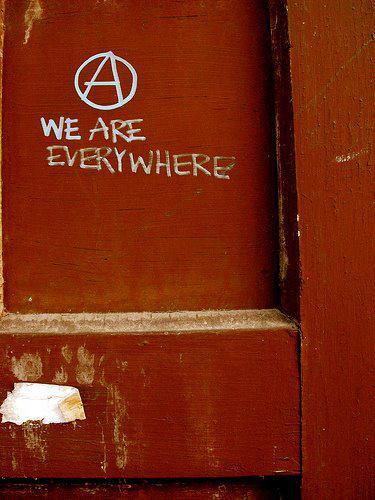
Image via anarchistart.com.

Enter your email address:


Delivered by FeedBurner
Read More »

Featured

There’d Likely Be Another Civil War Before Ukraine Meaningfully Turns Away From The West

There’d Likely Be Another Civil War Before Ukraine Meaningfully Turns Away From The West By Andrew Korybko For as much as the Telegraph fear...

Follow Me on Twitter